Thursday, May 8, 2014

Wild for Wonderful Wildflowers at The Woods

If you haven't seen your share of wildflowers, you absolutely must take walk along our Wildflower Trail and visit the Faust Garden here are Baltimore Woods. I guarantee you it will make your day.

Unlike garden flowers and floral arrangements you can buy in the store, wildflowers have a unique appeal that will surprise you. Many wildflowers you see around Central New York are not that large, but boy are they gorgeous. A familiar flower you may have seen already - just take a look at a white trillium...

Trillium grandiflorum
 and the red trillium!
Trillium erectum
Ah trillium. It’s smooth leaves and picturesque flower. It can blanket the ground here at the woods or it can stand solo in the leaf litter under the beech and maple trees.

White trillium on forest floor at Baltimore Woods
Their 3 large, showy petals will catch any hiker’s eye. Petals, sepals, and leaves all in perfect symmetry make the trillium a symbol for so much in our culture. Often used as a logo  like Wake Robin, the province of Ontario, heck even us.
Find trilliums in partial shade – in the forest or maybe under a forsythia in your garden. They require moist, rich soil and will flower year after year once they’ve taken their time to establish.

Among the trillium, especially at Baltimore Woods, right now you may find an assortment of other beautiful wildflowers. Including but not limited to:

Trout Lily
Twin Leaf
Double bloodroot
Bloodroot
and my personal favorite...
Podophyllum peltatum
Mayapples! Right now they look like the picture shown above but just a few days ago they looked like this:


With a reddish hue to their leaves, the "umbrella" had not quite opened up yet and was still unfurling. The plant shoot can grow over a foot tall and soon a single large flower will bloom between the two umbrellas.


The apple part of the plant's name comes in after the flower blooms, of course. This plant produces a lemon-like fruit that is said to be edible. But beware! The fruit is only safe to eat when it is fully ripe and then only in small amounts. The unripe fruit and the rest of the plant are very toxic! I haven't tasted one of these fruits yet, finding a ripe one is tough when you're competing with squirrels.

We are lucky to have such a grand assortment of naturally growing flowers on our property. But you have to get out today! A flower on a twin leaf will bloom for only one day! So get out there - you've been waiting all winter for this!

Speaking of flowers, another once a year opportunity is upon us with our Mother's Day Garden Tour. You will get the unique opportunity of visiting the gardens at Sycamore Hill all while benefiting Baltimore Woods and its precious flowers.

Monday, May 5, 2014

Our Transformation from Fields to Woods

When you visit Baltimore Woods and hike through the woodland of tall, shady trees, it’s easy to imagine that Baltimore Woods has always been covered with trees. But not so long ago, it would have been more appropriate to call the preserve Baltimore Fields.

Before the European settlement, there was a mix of open land and young forest across our region. These habitats grew up after Native Americans burned woods to improve hunting and clear land for farming. Unchecked wildfires and storms leveled forested lands, and large herbivores kept areas open by browsing the regrowth. These influences gave rise to expanses of grassland as well as large areas of densely-regrown trees and shrubs.

It is likely that some of the area that we now call Baltimore Woods was forested until the late 1700s, when the first Europeans settled in Marcellus and began to transform the land. With axes, fire, and other tools, the woodland was soon cleared to make way for farming and timber to build the growing nation.

For the nearly two centuries, what we now call Baltimore Woods was mostly farmland. And by the 1920s, when agriculture was at its peak in Central New York, less than one quarter of the preserve was covered in trees. Even in those areas, some logging was probably taking place.

A series of aerial photos, beginning in 1938, tells the story of how the land changed during the 20th century. The 1938 photo shows the extent to which the land was worked, with all but the steepest areas either tilled or pastured.
1938
In the 1950s, the farming began to be phased out of the less-productive areas, and first signs of brush start to slowly creep in.

1950's
By the mid-1960s, large sections of the property are clearly becoming brushy pastures and some of the wooded sections have started to expand.

1960's
By the time that ‘the Woods’ had been protected in 1972, most of the farming had stopped and the reforestation was allowed to happen unchecked; many of the brushy fields had started to become young forest. But a hand drawn map from the early 1980s still shows large areas as open land. The period between mid-1980s and mid-1990s is probably when Baltimore Woods held its greatest diversity of habitats and provided a home to the widest variety of species, with its good mix of open field, shrub fields, young forest, and older forest.

1980's

By the mid-1990s, the open areas were beginning to disappear as the brushy areas continued to grow into young forest, and the young forest into older forest.  As open areas declined, so did the plants and animals that called them home. This loss did not go unnoticed.

1995
In the early 2000s, the Boundary Trail was constructed, partly to provide better access to the remaining open areas so a tractor, equipped with a brush mower, could start to halt the loss of habitat. In the mid-2000s, aggressive action was taken, and a volunteer with a bulldozer cleared acres of brush around the remaining meadows; the vegetation removed was mostly exotic invasive species.

2006
Today we continue our work to protect, restore, and expand the open meadow areas. Our new land stewardship plan will help guide us to maintain a good diversity of species, both plants and animals, that call Baltimore Woods home.

2011
So, next time you visit the Woods, stop and take a moment to think that once, and not all that long ago, most of this was open land and only a little bit of the Woods was wooded. 


Why it’s called Baltimore Woods:

In the 19th century, most of the 180 acres that we now know as Baltimore Woods Nature Preserve was working farmland. At that time, the majority of farmers in this area marketed their cattle in New York City. It seems that one of those farmers, however, had a falling out with his NYC middlemen and decided to send his cattle to market in Baltimore instead. So, he purchased and worked a piece of property located close to the railroad line that went to Baltimore. In fact, remnants of that now-defunct train line can still be found on the east side of Lee Mulroy Road. It's funny which names "stick" sometimes: the feisty farmer's former lands and the brook that meanders through them now carry not his name, but the exotic and evocative name of distant "Baltimore."

The Baltimore Woods area has been farmed for at least 150 years with the peak of agriculture coming sometime between 1900 and 1920. At that time only about 30 acres of woodland remained in what is now Baltimore Woods, including the steepest parts of the south slope of Baltimore Valley and a small block of hardwoods at the southwest corner of the Parson's Parcel.

When agriculture began to be phased out the 1950s, in most of Baltimore Woods plant succession slowly took over adding acres of pioneer forests, shrublands and scattered herbaceous clearings.

Today, the average visitor to Baltimore Woods would not recognize the differences between the more recent forests and the "original" forest tracts. However, analysis of these forests based on species and DBH (trunk Diameter at Breast Height) reveals differences which provide educational opportunity and suggest management needs.

Baltimore Woods Becomes a Nature Preserve

In the mid-1960s a committee of representatives from local nature and environmental groups met to discuss the preservation of natural areas in Onondaga County. Baltimore Woods was one of a couple of dozen natural areas deemed worthy of preservation.

In 1972, people from this group formed Save the County to begin the process of acquiring and setting aside a number of these areas for preservation.

An Uninvited Guest

When you visit Baltimore Woods you may not realize that one of the dominant shrubs in the Woods is an unwanted foreign invader.
Tartarian honeysuckle (Lonicera tatarica), a bush honeysuckle,
crowds and shades out native plant  pollinators.
Quick facts:
  • Eastern Asia Eurasia
  • Introduced to the US as an ornamental plant in the mid 1700’s it was also planted  for wildlife cover and for soil erosion control.
  • Shaggy grayish brown
  • Naturalized in most of the US
  • Reduces biodiversity
  • The seeds are distributed to new areas in bird droppings
  • For more information, visit http://www.nps.gov/plants/alien/fact/loni1.htm


Wednesday, April 23, 2014

Dance of the Timberdoodles

Spring is in the air and the animals are showing their enthusiasm by displaying their love for one another. Some animals have quite strange ways of showing their affection and attracting a mate. One such creature is the unique looking American Woodcock also called the timberdoodle or bog sucker.


Their strange looks help them to survive. Their large eyes help them to see above to avoid an aerial assault when they are feeding and they use their long bills to probe into the ground for juicy earthworms. Did you know these plump timberdoodles are shorebirds? It’s true, they just happen to be the only ones that frequent such places as forests and fields.


I always get so excited to hear the Woodcocks; it’s a sure sign that winter has finally ended! I usually hear them in late March, early April up at Lab Hollow when we do our Amphibian Alert (as you read about in Tom’s previous blog post). Lately I have been hearing them almost every night in the field next to my house in Skaneateles. Have you heard this nasally peeent call? It’s the male calling loudly to the females that he’s here and ready for action! Check out the funny video below to experience this sound for yourself!


Another way male Woodcocks attract the females is by showing off their fancy dance moves which the video below captures perfectly!


The most unique part of the mating ritual happens at dusk. The male Woodcocks perform their sky dance while making whistling noises with their wings. It’s really quite impressive the way they zig and zag in the air, looking like a rotund bat! Once they have spiraled down from high in the air they chirp and then land silently near a female (if she is nearby) and begin to peent – inviting the female in for a private dance for two.

Woodcocks are ground nesters and the females lay their eggs about a month after accepting the male’s invitation. The males are not involved in the rearing of the young and will meet several other females before spring is over. Being that they are ground nesters and thus susceptible to predators the young need to be up and out of the nest soon after hatching. They will stick around the area though to get eating pointers from mom.

It’s not too late to get out and observe these amazing shorebirds in action! At dusk find a field and there is a good chance you will hear the call. Isn’t love grand?

Wednesday, April 16, 2014

The Big Night

Spring nights hold a certain magic for me. After the long silent winter nights, there’s something energizing and refreshing about the sounds and smells of a spring night.

Earlier this week I took a drive down to Labrador Hollow in search of all that a spring evening has to offer. I pulled into the parking area just after 7:00 pm, as the sun was sinking and painting the sky pink and blue. My hatchback is just tall enough for me to sit back with the door open, affording me a view of the large fields and the surrounding hillsides.

It wasn’t long before the magic began. From my right I could hear spring peepers singing their high pitched songs. A barred owl called out from somewhere on that hillside, “Who cooks for you? Who cooks for you all?” From above came the twittering of a courting woodcock as it flew in slow circles against the now deep blue sky. The moon was bright and full, illuminating the field and casting soft shadows.

It was almost time…

Gathering my camera equipment, headlamp, and tall waterproof boots, I began the walk down the road in search of one of the most magical events of spring. For anyone who has attended one of our Amphibian Alert Programs, you will know exactly what I’m about to describe…


Walking along the moonlit road, directing my headlamp at every stick, rain puddle, or drifting leaf, I searched for the stragglers of a yearly event known to herpetologists as the “Big Night”.

Yellow-spotted salamander (Ambystoma maculatum)
There! I see the outline of an 8-inch long spotted salamander, head held upright as it scouts the road which it must cross. And there was another! And there – a wood frog! Toads! A little bouncing ball springs across the road – a peeper! Listening carefully I could hear the rustle of leaves as salamanders crawled down the hillside on their way to the vernal pools – those ephemeral ponds, existing in depressions only so long as the water table remains high. 

Yellow-spotted salamander (Ambystoma maculatum)
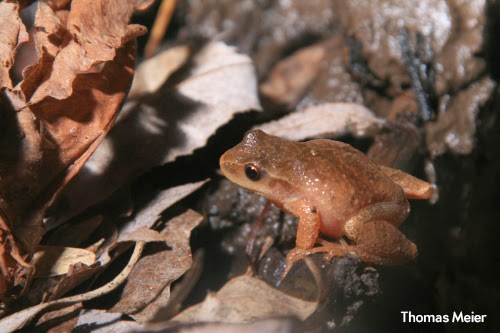
Wood frog (Lithobates sylvaticus)

Jefferson salamander (Ambystoma jeffersonianum)
Coming up on one of the pools the first thing I noticed was the constant high pitched peep! of spring peepers – the smallest of our native New York frogs, not much bigger than your thumb pad. But they win for sheer vocal volume. Standing too close to a pool full of singing peepers is an experience more felt than heard as the pulsing of hundreds of peepers turns to a weird drumming sensation in your ears. 

Spring peeper (Pseudacris crucifer)
Swimming wood frog (Lithobates sylvaticus)
Wood frogs gurgled away, expanding special sacs on their sides, forcing air back and forth over their vocal chords. Shining my headlamp across the pool I was greeted with a hundred round spots of light reflecting back at me, every one a wood frog eye. 

Swimming yellow-spotted salamanders (Ambystoma maculatum)
Jefferson’s and spotted salamanders moved along the bottom of the pool, crawling through leaves, over one another, occasionally rising to the surface. The males are competing for a chance to bump noses with a female, after which they will deposit a white column on the leaf litter, called a spermatophore. The female will later move through and pick up one of these columns using her cloacal vent at the base of her tail, making these salamanders to be one of the few amphibians that utilize internal fertilization.

This explosion of sound and life happens just once a year, on that first warm rainy night. Some years it may last a few days, if conditions are not ideal. And then, just a few days later, they are gone. The pools are quiet and still, the moment has passed, and all that’s left to show for it are gelatinous egg masses in the water, hope for the future. In a few weeks the eggs will hatch, the salamander larvae will develop and eventually move up into the forest where they will spend the rest of the year in dark tunnels. 


Next year they will make the half-mile trek back to the vernal pools to repeat the process all over again. And on that first warm rainy night of spring, you can bet I’ll be there too, watching for the magic, more than ready to share my own eagerness for spring and life, and not in the least deterred by a little rain.  


Blog post by Tom Meier

Monday, April 14, 2014

Maple Magic

If you live in central New York, you have probably seen Sugar Maple trees decorated with buckets and tubes, collecting sap to make that sticky pancake topping we adore. Last week when I was sitting underneath a grand Sugar Maple, preparing to teach our Nature in the City first graders about this remarkable process, I noticed something astonishing. I was surrounded by the maple’s winged helicopter seeds and they were all standing vertically as if they had grown straight up out of the Earth. 

A sea of seedlings. Do you see??

Upon further inspection I realized that they actually were growing out of the Earth! Thousands of Maple seeds had sprouted and the winged seed coats were still clinging to the little seedlings, protecting the baby leaves until they outgrew their tiny shelter. They had waited under the snow all winter long for this breathtaking event.

Standing sprouts

Sprouting samara

After doing some literal digging to inspect the infant Maples, I did some figurative digging and discovered that Sugar Maples tend to produce massive amounts of viable seeds cyclically, usually at 2 to 5 year intervals. This great Mother Maple must have done something right because she certainly had one of these good years. I can imagine the school 30 years later, surrounded by a forest of Sugar Maples in the middle of Syracuse. Alas, the seedlings’ fate is sealed; in a few weeks they will all be cut along with the grass, but I will not forget this magical event. It just goes to show that no matter how much time you spend outdoors, nature will always have new surprises in store.


Blog post by Emily Van Ness