Wednesday, February 5, 2014

Tales of the Snow: The Art of Tracking


Recently, Baltimore Woods hosted a tracking event presented by the great and extremely talented Mr. Steve Montross. While a snow storm hindered many from attending, I managed to fight the winter roads and, needless to say, I found it was well worth it. 

During the presentation Steve talked extensively about the art of tracking, print tracking in particular. He described two ways to approach natural observations. The first type, of which I'm more familiar with, consists of making a check list and marking off the life list as you see new things. He explained this as being similar to meeting everyone at a party and just learning their names and what they looked like. The second way consists of taking a closer, deeper look at a particular subject, or choosing one person at the party to talk to, meet, and befriend. Steve gave the example of one watching the same robin every sunset from a comfortable rocking chair on your back yard porch. Eventually you learn more then just the robin's markings and call, your start to meet the robin and know its habits. Life details such as where it nests, its favorite evening treats, what times and where it enjoys calling to its neighbors, even its favorite bathing puddle. This second type of natural observation is what tracking lends itself to. It helps you discover and learn the spirit of an animal and do more then just mark off that this animal lives in the area, tracking allows you to explore and learn who that animal is.

First Steve took us through the basic tracking necessities: a map, flash light, first aid kit, compass, measuring tape and reference book (see bottom of article for reccomendations) to begin with. Next was some print tracking 101, like the common prints we'd likely see in the area, how to tell which way the animal was walking and if it was accelerating. He also explained the types of amazing details true experts can inference from tracks alone. Trained trackers can deduce if a dog has eaten earlier in the day, weather a cat is a house cat or a feral feline, if a fox is feeling anxious and might know you're in hot pursuit. He said real experts could even track a woodland jumping mouse over the slick rocks of Bald Mountain. Like a real life Sherlock Holmes (a tracker himself) Steve showed us how much of the skills of tracking consists of a combination of science, observations, and deductions from those observations.
A picture of the beautiful stream running through Baltimore Woods taken during our tracking adventures on that snowy day.
Next Steve took our small party out into the freshly fallen powder and the beautiful snowflake sparkling trails of Baltimore Woods. While I initially thought fresh snow would equal wonderful clear prints, I quickly realized I was mistaken. All the tracks from the previous night had completely disappeared under a white fluffy blanket and the wind was threatening to fill in any new prints that might have occurred more recently. On the other hand, we knew that all the tracks we did see were fresh and it told us who was out during that time of day and that they must be close by. 

We spotted our first prints of the day right outside the back doors, on and around the deck. The little footprints of happily hopping dark eyed juncos and chickadees speckled the lightly snow-laden porch and picnic tables, while just off of the porch we mapped the trail of a bounding red squirrel. Steve pointed out how the squirrel plans its path by moving from tree to tree, making sure an escape route is always close at hand. 

Later in our tracking adventure, we were also able to barely make out the tracks of two deer, only slight depressions in the snow; we deduced they must have been walked through a few hours before we arrived. It reminded me of something Steve had mentioned earlier, how each animal, just like people, has a different stride. By measuring and noting an animal's stride you're able to pick them out amongst a group of many and continue following only that single subject. We also stumbled upon a patch of hemlocks littered with clues about the happy daily activities of more nearby red squirrels. We finished our day seeking out a rumored fox den and trying to trace their tracks backwards to see where the foxes had come from and how they patrolled the area.

A picture of Steve picking out some red squirrel tracks amongst the hemlocks.
Overall the day was an enlightening new way to look at the spirit and lives of the wildlife that surrounds The Woods. I'd love to take some time to become friends with and learn the habits of our new beaver friends that have taken refuge on the premises. Or maybe stop by more frequently to visit that fox den and see if I can figure out where they're patrolling and who's calling that den home. 

Steve described the art of tracking as being one, like so many of the skills of older times, that's declining in popularity. His passion for tracking is contagious though and it seems to me that I've caught the bug too and there's no better place to hone my skills than at beautiful Baltimore Woods!  Hopefully we can all take a little time this winter, when the tracks are crisp in the snow, and the sun shines warm, to follow in the footsteps of a nearby nesting neighbor. Who knows, it might be a perfect opportunity to meet a new furry friend and see what a day in their shoes is like and glimpse at who it is they really are. 

To learn more about the art of tracking some recommended references are:
  • The Tracker by Tom Brown Jr.
  • Tracking and the Art of Seeing by Paul Rezendes
  • Mammal Tracks and Signs by John Elbroch
  • The Science and Art of Tracking by Tom Brown Jr. (for the more advanced)


Special thanks to Steve Montross for answering my onslaught of questions and inspiring me to write this article. 


Blog post by Kyle L. Teufel

Thursday, January 30, 2014

The Warmth of Snow

A blanket of snow covers Central New York and with it come chilly temperatures. Although the freezing temperature may keep us inside, the snow gives us a great opportunity to see what kinds of wildlife are right outside our door.

Winter is a time for dormancy for many animals, but not all. Take a walk through The Woods and you'll find tracks from deer, rabbit, fox, raccoon, squirrel, and maybe even mink. These mammals have great furry bodies to help keep them warm during the winter but the smaller mammals use the snow to keep themselves warm.

Yes, that's right. Small mammals use the snow to stay warm. This actually isn't as crazy as it sounds. Layers and layers of snow can create an insulation where animals like mice, voles, and shrews can seek shelter from the cold and from predators. As they scurry under the snow, they make tunnels. You can see evidence of tunneling that look like this:


 And when all the snow melts away, you'll find their tunnels in the grass like this:


Seeking shelter under snow eliminates the wind chill factor and with the benefits of the snow's insulating properties, this makes a huge difference to those small animals and for humans, too. Have you ever built a quinzee? Although you may not have heard of this term, if you have ever dug into a pile of snow that was plowed to the end of your driveway, you've made a quinzee.

Try it!
You will need:
  • A lot of snow
  • A shovel
  • Waterproof winter apparel
Build a snow pile that's as tall as you are. Once you've made your pile of snow, go find yourself a hot beverage or go for a hike: the snow needs to settle for at least an hour. To make an easy quinzee, start with snow that's already piled up. As I mentioned before, those piles of snow left by plows are great starters and they've already been sitting around and settling. When you come back to your settled snow, now you can start digging. Once you've excavated a space for you to crawl into, spend a little time in there. Maybe even spend the night! Eventually your body heat will be insulated by the snow and you'll find the space to be quite comfortable.

The snow and cold is inevitable in CNY and many of us embrace it through sledding, snowshoeing, cross country skiing, downhill skiing, or snowboarding. Our time is mostly spent on top of the snow but I'd like to challenge you to spend some time underneath the snow!


Blog post by Anna Leiss

Monday, January 27, 2014

The Story of a Little Acorn: How an Old Farm Became Baltimore Woods


This is a story of how a few organizations - - and many, many children - - turned an old farm into a nature preserve, created a permanent home for nature education, and spurred a nature conservation movement and a partnership that is still going strong over forty years later.


On a cold and snowy Saturday morning in late April of 1972, over 3,000 people, most of whom were  elementary school students, started out on a fifteen mile ‘walkathon’ that was organized to raise money to protect natural areas in Onondaga County, and one piece of land in particular.

A few years earlier, several local nature and environmental groups had started discussing the need to protect the vital natural areas in Onondaga County, and they formed a coalition to tackle the problem. The one unprotected natural area that was at the top of everyone's list was a tract of mostly abandoned farmland in the Town of Marcellus.

The weedy overgrown fields, the scrubland, and the small pockets of old growth woods had become known as one of the best places to go to watch birds and find wildflowers. People learned that the old farm would soon be put up for sale, and was already being scrutinized as site for an open pit sand and gravel mine.

The coalition of nature and environmental groups approached the town (Marcellus), the County, and then the State to try to persuade them to protect the property as a natural area. However, they were turned down at every step. Eventually, the coalition convinced The Nature Conservancy to agree to buy the property before it could be clear cut and turned in to an open pit mine. Unfortunately, The Nature Conservancy did not want to own or maintain the property, and they also stated that they needed to be paid back.


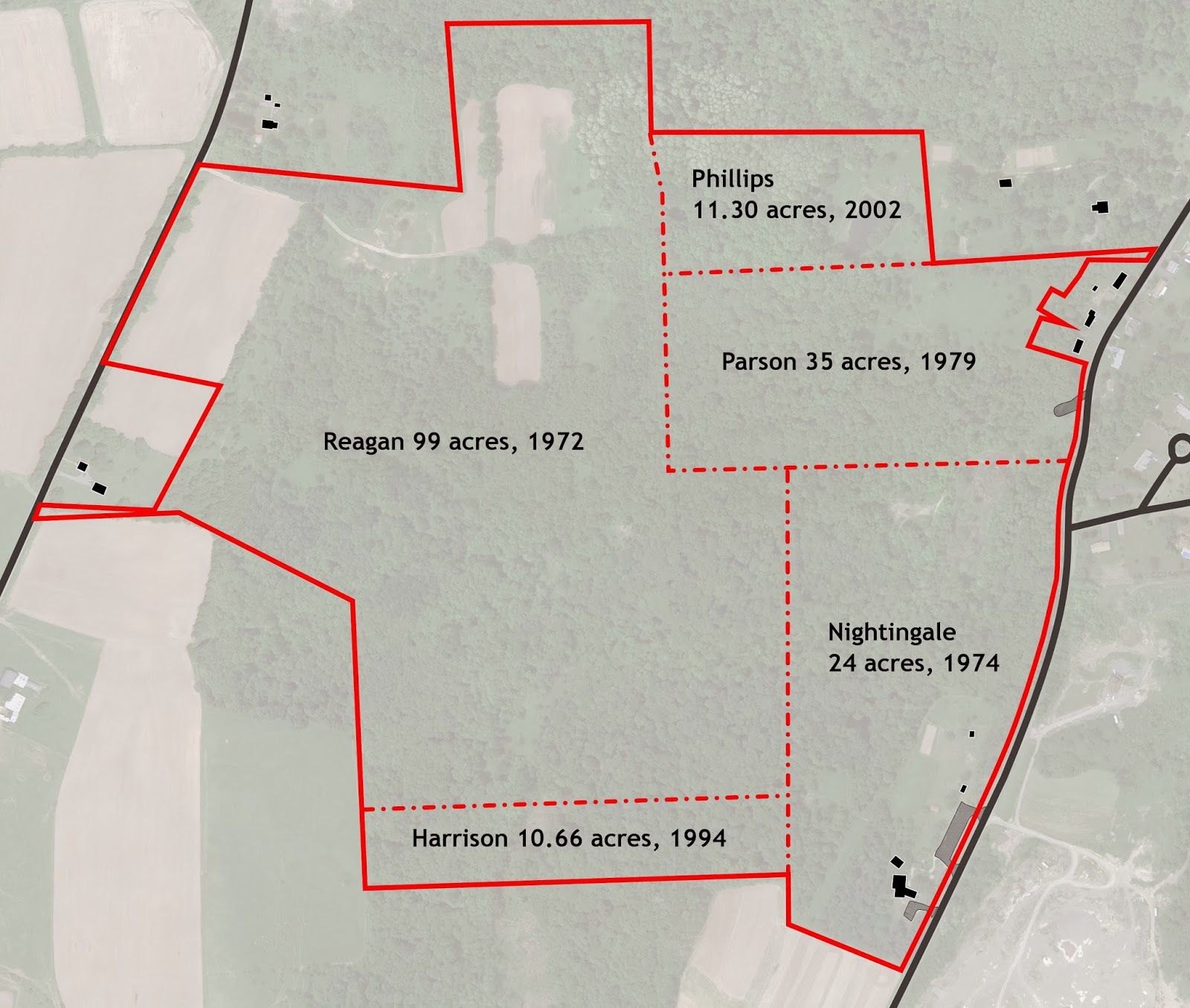
The coalition then formed a separate organization, called Save the County (STC), to handle the necessary fundraising to pay for the Marcellus property as well as other natural areas in need of protection. STC hit upon the idea of a walkathon that would enlist schoolchildren and other concerned people to get monetary pledges for each mile walked. That was the origin of the snowy walk in April of 1972, and it was a great success, in terms of both participation and fundraising. The first Walk to Save the County raised over $24,000, and two months later, the purchase of the first 99 acres of the parcel was complete. The land purchased was the core of what would later become known as Baltimore Woods Nature Preserve.


The Walk to Save the County became an annual event and grew even more successful, raising more than twice as much money the following year. Save the County was then able to reimburse The Nature Conservancy and began looking for someone to take over the ownership of the property. Once again, the Town, County, and State all declined to take ownership of it, so Save the County incorporated and expanded its mission to own land as well as to fundraise for the protection of natural areas. 

A few years later (1975), Save the County paid for the purchase of a 24 acre addition to Baltimore Woods. At around this time, one of the original coalition member organizations, Onondaga Nature Centers (ONC), was starting to look for looking for a new home. ONC (founded in 1966) had been running the nature center at Beaver Lake County Park, but the county was ready to take over the operation at Beaver Lake, and Baltimore Woods was the natural place for ONC to move.


In 1976, Bicentennial fever swept the land, and ONC drew up plans to turn Baltimore Woods into a Historic Land Use Center that ONC would run. The Historic Land Use Center was going to feature living history with an Indian village, a pioneer homestead, pioneer village and an 1870s farmstead.  That same year STC finished paying back The Nature Conservancy.


In 1977, The Nature Conservancy transferred the property to STC with the stipulation that the property would be used as a nature education center and ONC began to host regular educational programs there as well as taking over the stewardship for the property.


In 1978 development of the property had begun, the first trails were added, an old farm house was moved to the property to serve as the headquarters for ONC and construction began on the pioneer cabin, unfortunately interest in historic reenactment rapidly waned and the pioneer cabin was the only part of the historic land use plan to be realized.


The coming years more land would be added to the nature preserve in 1979, 1982, 1994 with a final addition in 2002 that brought Baltimore Woods to its present size of 179 acres.


Over time, both Onondaga Nature Centers and Save the County grew and evolved, ONC eventually changed its name to Baltimore Woods Nature Center because it had become so synonymous with the nature preserve.

Save the County transitioned its mission from fundraising for conservation to direct land protection and changed to Central New York Land Trust (CNYLT). From that first 99 acres CNYLT has gone on to protect over 2,800 acres on 49 nature preserves. 

The partnership between the Nature Center and the Land Trust is still going strong today with the ownership of The Woods split between the two, the Nature Center owns the land around the Interpretive Center and the Land Trust owns the majority of the Woods.

As the proverb goes, “Mighty oaks from little acorns grow”.


Blog post by Jeff Devine

Monday, January 20, 2014

The Business of Beavers

To say that the American Beavers Castor canadensis have been busy here at Baltimore Woods is an understatement. These large rodents (the largest in North America) have dramatically altered the landscape in the past 3 years.

So is this a bad thing? Are they destroying the habitat?

The answer is no. Beavers are part of the ever present ebb and flow of nature. Beavers do not destroy; they create new ecosystems which provide habitat to flora and fauna alike. This makes them an important keystone species.

Now, I am not saying that when I walk down to the valley I am happy to see that our stream has expanded to a pond, but instead of taking a negative view I try to see this as an opportunity to explore a new habitat. It is exciting to see all the species, especially birds, that have come to call this wetland their home. Examples include Green Herons and Belted Kingfishers.

Let us take a look at the brilliant engineering abilities beavers possess and look on their lodges and dams with awe because it is indeed amazing that these animals are able to accomplish so much in such a short amount of time.

This is a photo of what we have aptly named the Beaver Pond. You can see the Boundary Trail on the far left side. This was once a small trickling stream amongst dense vegetation. To the right of the trail is one of their lodges. Check out the video at the end of this blog to see what a lodge looks like inside!


Here is a close up photo of one of the lodges located right on the Boundary Trail. Beavers are active all winter long and are able to access their lodges from underwater entrances.
 

Beavers use their strong teeth to strip the bark from the trees which they then eat. Nothing is wasted in the building process. The trees and branches they chew down are then pushed or carried (beavers can carry as much as their own weight) and strategically placed to block water flow. This creates a safe pool for their lodges; away from predators on land.

Below is a photo of one of the beaver’s newest dams, located between the two bridges on the valley trail.


Below is the dam located near the lower parking lot along the Boundary Trail.


Beaver tracks are easily spotted in the mud and snow by their large webbed feet in a waddle type pattern. Webbed feet help them to be excellent swimmers; they can even stay under water for up to 15 minutes! With an extra set of eyelids; which act as goggles, beavers are able to see underwater as well.


Above is one of the many beavers (at least 6 beavers in this colony) we have here at The Woods. The best time to see them is at dusk and dawn, though many visitors have seen them busily swimming during the day as well.

Although they may look cute, beavers can be aggressive and are quite territorial so be sure to keep your distance. Especially if you hear them giving you a warning by slapping their tails against the water!

Speaking of tails, check out this great picture below! Beavers can reach 29-35 inches long and weigh as much as 60 pounds! Much of their length is attributed to their tails which can be as long as 16 inches long and up to 7 inches wide! Their broad, stiff tails are important in that they act as a rudder as they swim and help to balance the beavers when on land.


These next pictures are a testament to how strong the beaver’s teeth really are. With a coating of tough enamel (which makes the teeth an orange-ish brown) the beavers are able to gnaw through pretty much any kind of bark.


Though their primary food and building sources are aspen, cottonwood, willow and dogwood; we are seeing them fell trees such as Eastern Hemlock, birch and beech trees here at The Woods. Once their food source has been diminished beavers will move downstream to a new location.

Below is a beaver mount at the Montezuma Audubon Center in Savannah, NY. You can really get a good look at those teeth and sharp claws!


I leave you now with this wonderful video which shows beavers constructing a lodge and even what the inside looks like! Enjoy and be sure to come visit our beavers here at The Woods. Remember beavers are an important part of the ecosystem and are only doing what they need to do to survive. They really are amazing engineers!


Blog post by Becky Williams