Monday, October 28, 2013

If Trees Give You Walnuts, Make Pie.

When the leaves are starting to fall, so are the black walnuts. The nuts seem to be everywhere: stuck in your lawn, speed bumps on your driveway, ankle breakers on the sidewalk, or maybe just the husks are  piled up after a squirrel's feast like the one I found along the Pioneer Trail (shown below). And when they fall, boy do they fall hard. If you have a black walnut tree growing near your house, don't be alarmed by the occasional loud - THUMP of a walnut dropping on your roof. Sometimes these nuts can be a nuisance but they do a whole lot more.

Black walnut husks gathered on a stump.

What does a black walnut look like?

Black walnut (Juglans nigra) trees have a tall straight trunk and leaves that can have over a dozen leaflets. The walnuts hang in clusters of two or by themselves. This time of year, just look for nuts on the ground that are about the size of a tennis ball and about the same color, too. Just don't try to bounce one. It won't work. Trust me, I've tried.

I've found a black walnut nut. Now what?

Pick one up and take a good whiff. They usually have a bit of a lemon-like scent, but if you pick one up after its been lying on the ground for a while, it may smell like a rotting lemon. This is normal. 
The first layer is very fleshy and green, called the husk. Peel away the husk to reveal the nut. You may have noticed as you peel away the husk that now your fingers are getting a little discolored. Now they may smell like a rotting lemon. I suppose I should have warned you about this first. Black walnut husks contain a powerful dye. I might suggest wearing gloves before you hull your next walnut. Black walnut husks also contain an herbicide.

An herbicide, eh?

To other plants and some animals, yes it is but to humans it is generally non-toxic. This herbicide is called juglone and is found is the husk of the fruit and in the roots of the tree. If you have a black walnut tree, it's very likely that it's standing alone or among more black walnuts. The herbicide will prevent certain other plants from growing around the tree, therefore reducing competition for nutrients and space. This clever technique is called allelopathy.

What about the pie?

Inside those thick husks are delicious walnuts. One tree can produce about 100 pounds of nuts, that's equal to about 400 nuts per tree per season. That's a lot of nuts! Squirrels especially love these nuts but you can enjoy them, too. You can remove the husk and wash the nuts. Leave them out to dry for a few weeks and then you can crack open the shell and extract the meat of the nut. You can then use these nuts in whatever way you wish. How does black walnut pie sound?

Learn how to crack your own black walnuts:


Then make your own black walnut pie.


Blog post by Anna Leiss

Thursday, October 10, 2013

More Than Monarchs Take Flight from Cold CNY Winters

As the leaves begin to change, so does the wildlife in Central New York.  The temperatures drop and food gets scarce, big and small animals need to adapt to these seasonal changes. Many animals choose to migrate to warmer areas, including insects. The most charismatic insect to do this is the Monarch butterfly.  From when we're in grade school, we learn about the Monarch butterfly and its triumphant journey to Mexico but Monarchs aren't the only butterflies that migrate.

How many other butterflies migrate?
The North American Butterfly Association has listed about a dozen butterflies that fly south in the fall and back north in the spring.

Which butterflies at Baltimore Woods migrate?
Of the butterflies that are seen at Baltimore Woods, the Question Mark, Mourning Cloak, Painted Lady, and Red Admiral all migrate south in the fall in addition to the Monarch. They may not fly as far as Mexico but they will still fly to the southern United States and will often migrate in very large numbers.

     
Question Mark Polygonia interrogationis
Mourning Cloak Nymphalis antiopa
Painted Lady Vanessa cardui
Red Admiral Vanessa atalanta

Baltimore Woods has a fantastic selection of nectar plants for these butterflies, especially near the log cabin. Take a walk on one of these warm fall days and see which butterflies you can find. Not much is known about the migration of other butterflies because they're not as heavily researched as Monarchs. What I do know is that I'm still seeing Mourning Cloaks and Clouded Sulphur butterflies around Baltimore Woods on the sunny days we've been having.

Where do butterflies go if they don't migrate?
Most butterflies do not overwinter as adults. Swallowtails, for example, can be found as pupae buried underground and will emerge as adults in the spring. For those butterflies that do withstand winter, they seek shelter and go into diapause.

Woolly Bear caterpillars


Woolly Bears are not butterflies (they are the Isabella Tiger Moth Psyrrharctia isabella), they are still one of those familiar fuzzy bodies that are often seen crossing roads and paths this time of year. At some point in your life (probably when you were young enough to believe it) you may have been told a legend that the larger the orange band on woolly bear caterpillars, the longer the coming winter will be and vice versa.

What the large orange band actually means is how close the caterpillar is to overwintering. The orange band grows with each molt so instead of getting worried about how you're going to survive another frigid winter, you can determine if the woolly bear is ready for winter or not, depending on the length of its band. They will freeze solid throughout winter, producing a cryoprotectant in their tissues so they can continue feeding in the spring. From there the life cycle moves quickly and the larva hatches from an egg again in the fall.


What butterflies and caterpillars have you seen this fall?


Blog post by Anna Leiss

Monday, September 30, 2013

Serendipity at Baltimore Woods


"This past summer I was fortunate to be at the right place, at the right time, to have a very special experience by the brook on the Griffiths Trail.

I had just sat down when a beaver came swimming down from upstream. I could see something round and brown protruding from its mouth. When it was opposite me, about twenty feet away, I could see a beaver tail protruding from the opposite side - a beaver kit! She, and I assumed that it was its mother, swam over to the bank burrow and dove. A few minutes later she swam by me, minus the kit, and disappeared upstream. Soon she was back with another kit in her mouth, and dove by the bank burrow.

But on her next trip she did a most extraordinary thing, something in all of my hours of watching I had never seen and heard before. When she returned from the burrow, she swam in a circle in front of me, and emitted a groan-like sound. At the risk of sounding anthropomorphic, I felt as if she was sharing her concern with me. Then she continued upstream but in a minute or two was back, with no kit.

While watching beavers from the lower Valley Trail bridge, I'd notice that sometimes a beaver would disappear where a branch overhung the water. I suspected that there was a bank burrow there. We'd been having much rain so I suspected that it had been used as a nursery, and became flooded. She went back, but sadly was too late to save any more kits."

by Audrey Loewer, Baltimore Woods Volunteer


Baltimore Woods has been the setting of many wildlife sighting stories like the one Audrey witnessed. If you have a story you'd like to share, please e-mail blog@baltimorewoods.org.


Tuesday, September 24, 2013

A Brief Introduction

Welcome to Baltimore Woods Nature Center's Under The Log blog!

Each week this blog will be a resource for what's going on in the woods at The Woods. There's always a lot going on out there and we want to share as much as possible to promote environmental awareness and understanding for Central New York. This blog will serve as an online nature journal that's interactive. We will share fascinating nature news through photos, personal stories, videos, and helpful links and we encourage conversation! Nature can be enjoyed by everyone at any age and we want to hear what stories you might have to share and we want to answer your questions, too. So follow along as we explore these woods and find out what's under the log and more.

Monday, September 23, 2013

Jewelweed Goes Ballistic at The Woods


Walk down the Valley Trail and become surrounded in this moisture-loving plant. Early in the spring you can start to see the youthful sprout pop up out of the ground everywhere. Now that we're into autumn, the fruit of this plant is looking about ready to pop! Some of the plants have even grown so high they could tower over you (depending on your height, of course)! The tantalizingly plump fruits beckon you to give them a gentle squeeze and – POP! – seeds burst in all directions and suddenly that fat little pod has disappeared before your eyes.

How does it do that?!

If you're quick enough (or if the pod is slow enough), you might be able to catch the pod right after it opens. You might notice a bunch of curled up plant parts and maybe a few seeds left behind. You're looking at the aftermath of a ballistic seed dispersal mechanism.

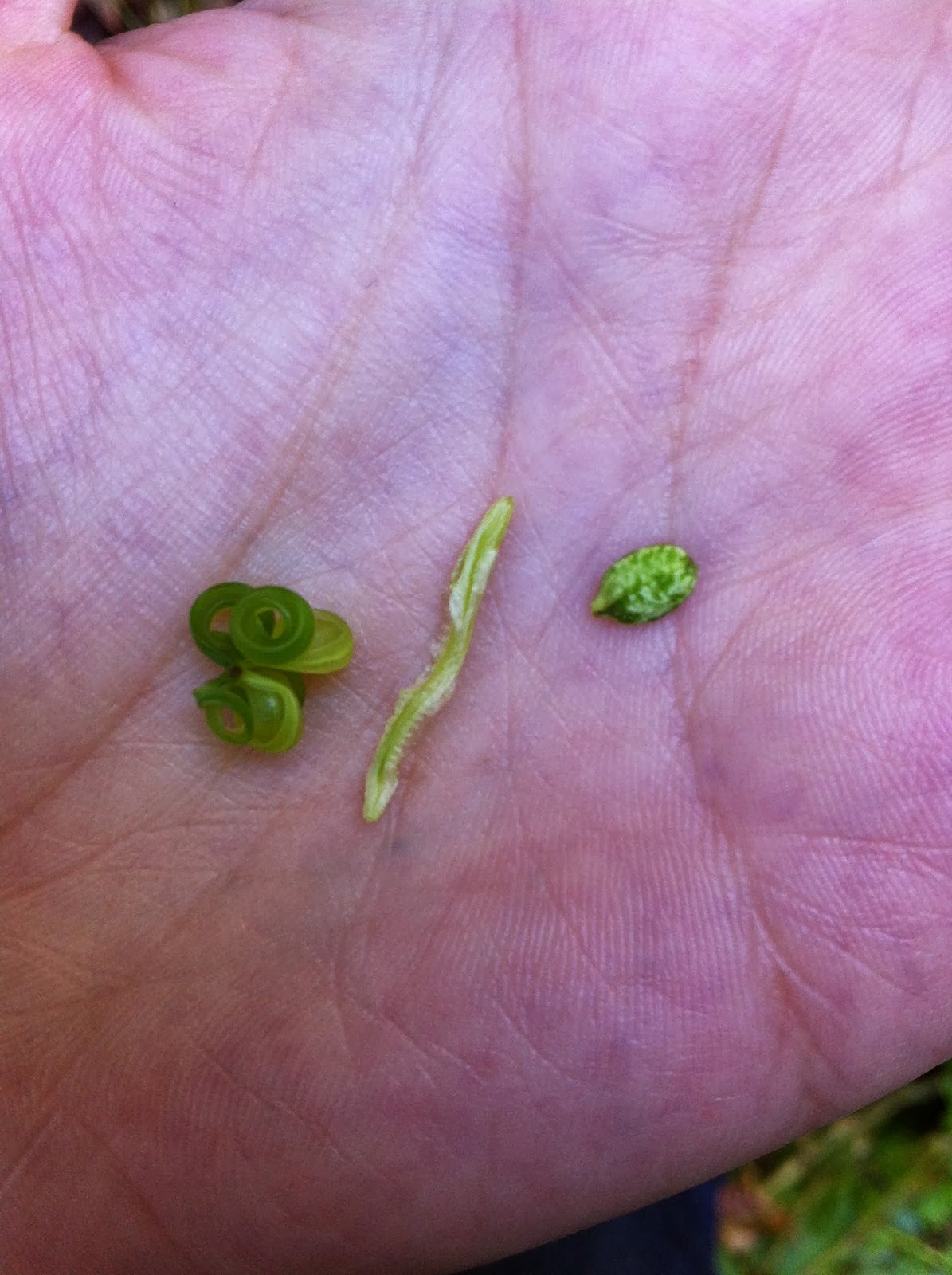
When a jewelweed fruit is ripe, there is so much pressure built up inside that the slightest touch will cause it to burst. Not too many other plant fruits will do this. When a banana is ripe, for example, it does not go ballistic when you grab it for your lunch. Inside the pod is a columella, surrounded by the seeds, and the whole fruit is enclosed by a few pieces called valves. The seeds are not attached in any way so when the pod is squeezed, the valves scrunch up, the columella collapses and the seeds get pushed out.

Deconstructed seed pod. From left: curled valves, columella, seed.


Read more

An article was published in the Journal of Experimental Botany where scientists quantified the ballistic dispersal mechanism of these seed pods. Read this fun and fascinating article here.

See for yourself


We have a lot of spotted jewelweed (Impatiens capensis) all around the woods. You'll find it especially near water like along the Valley Trail and the beaver pond. Stop by while the seeds are still ripe and watch the seeds launch!


Blog post by Anna Leiss