Wednesday, April 16, 2014

The Big Night

Spring nights hold a certain magic for me. After the long silent winter nights, there’s something energizing and refreshing about the sounds and smells of a spring night.

Earlier this week I took a drive down to Labrador Hollow in search of all that a spring evening has to offer. I pulled into the parking area just after 7:00 pm, as the sun was sinking and painting the sky pink and blue. My hatchback is just tall enough for me to sit back with the door open, affording me a view of the large fields and the surrounding hillsides.

It wasn’t long before the magic began. From my right I could hear spring peepers singing their high pitched songs. A barred owl called out from somewhere on that hillside, “Who cooks for you? Who cooks for you all?” From above came the twittering of a courting woodcock as it flew in slow circles against the now deep blue sky. The moon was bright and full, illuminating the field and casting soft shadows.

It was almost time…

Gathering my camera equipment, headlamp, and tall waterproof boots, I began the walk down the road in search of one of the most magical events of spring. For anyone who has attended one of our Amphibian Alert Programs, you will know exactly what I’m about to describe…


Walking along the moonlit road, directing my headlamp at every stick, rain puddle, or drifting leaf, I searched for the stragglers of a yearly event known to herpetologists as the “Big Night”.

Yellow-spotted salamander (Ambystoma maculatum)
There! I see the outline of an 8-inch long spotted salamander, head held upright as it scouts the road which it must cross. And there was another! And there – a wood frog! Toads! A little bouncing ball springs across the road – a peeper! Listening carefully I could hear the rustle of leaves as salamanders crawled down the hillside on their way to the vernal pools – those ephemeral ponds, existing in depressions only so long as the water table remains high. 

Yellow-spotted salamander (Ambystoma maculatum)
Wood frog (Lithobates sylvaticus)

Jefferson salamander (Ambystoma jeffersonianum)
Coming up on one of the pools the first thing I noticed was the constant high pitched peep! of spring peepers – the smallest of our native New York frogs, not much bigger than your thumb pad. But they win for sheer vocal volume. Standing too close to a pool full of singing peepers is an experience more felt than heard as the pulsing of hundreds of peepers turns to a weird drumming sensation in your ears. 
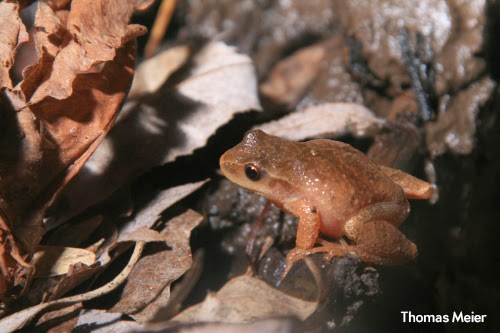
Spring peeper (Pseudacris crucifer)
Swimming wood frog (Lithobates sylvaticus)
Wood frogs gurgled away, expanding special sacs on their sides, forcing air back and forth over their vocal chords. Shining my headlamp across the pool I was greeted with a hundred round spots of light reflecting back at me, every one a wood frog eye. 

Swimming yellow-spotted salamanders (Ambystoma maculatum)
Jefferson’s and spotted salamanders moved along the bottom of the pool, crawling through leaves, over one another, occasionally rising to the surface. The males are competing for a chance to bump noses with a female, after which they will deposit a white column on the leaf litter, called a spermatophore. The female will later move through and pick up one of these columns using her cloacal vent at the base of her tail, making these salamanders to be one of the few amphibians that utilize internal fertilization.

This explosion of sound and life happens just once a year, on that first warm rainy night. Some years it may last a few days, if conditions are not ideal. And then, just a few days later, they are gone. The pools are quiet and still, the moment has passed, and all that’s left to show for it are gelatinous egg masses in the water, hope for the future. In a few weeks the eggs will hatch, the salamander larvae will develop and eventually move up into the forest where they will spend the rest of the year in dark tunnels. 


Next year they will make the half-mile trek back to the vernal pools to repeat the process all over again. And on that first warm rainy night of spring, you can bet I’ll be there too, watching for the magic, more than ready to share my own eagerness for spring and life, and not in the least deterred by a little rain.  


Blog post by Tom Meier

Monday, April 14, 2014

Maple Magic

If you live in central New York, you have probably seen Sugar Maple trees decorated with buckets and tubes, collecting sap to make that sticky pancake topping we adore. Last week when I was sitting underneath a grand Sugar Maple, preparing to teach our Nature in the City first graders about this remarkable process, I noticed something astonishing. I was surrounded by the maple’s winged helicopter seeds and they were all standing vertically as if they had grown straight up out of the Earth. 

A sea of seedlings. Do you see??

Upon further inspection I realized that they actually were growing out of the Earth! Thousands of Maple seeds had sprouted and the winged seed coats were still clinging to the little seedlings, protecting the baby leaves until they outgrew their tiny shelter. They had waited under the snow all winter long for this breathtaking event.

Standing sprouts

Sprouting samara

After doing some literal digging to inspect the infant Maples, I did some figurative digging and discovered that Sugar Maples tend to produce massive amounts of viable seeds cyclically, usually at 2 to 5 year intervals. This great Mother Maple must have done something right because she certainly had one of these good years. I can imagine the school 30 years later, surrounded by a forest of Sugar Maples in the middle of Syracuse. Alas, the seedlings’ fate is sealed; in a few weeks they will all be cut along with the grass, but I will not forget this magical event. It just goes to show that no matter how much time you spend outdoors, nature will always have new surprises in store.


Blog post by Emily Van Ness

Tuesday, April 8, 2014

MUD

There are so many signs of spring. Robins greet our freshly found, green ground. Sap is circulating inside trees. Buds are beginning to bulge, waiting for their moment to burst. Rivers and creeks flow free from frozen cover. But, perhaps the most magnificent mark of spring is the squishy brown, moist earth we call mud.

Mud for days. Photo credit: Emily Lawson
After a heavy, earth hardening winter a few spring showers soften our soil into a goopy goodness. This transformation from compact to creamy clay creates ideal conditions for one of my favorite groups of animals – amphibians! Mucking around in mud are salamanders, frogs, and toads! Their sensitive skin desires defense against desiccation, or drying out. So, when spring brings wet weather, and I see my first mud puddle I know my permeable companions are not far behind!

A salamander loves the the slimy mud. Photo credit: Tom Meier
A green frog enjoys the mud and sunshine. Photo credit: Tom Meier
Following in amphibian footsteps, mud makes a happy habitat for me. I love squishing mud between my toes, making mud prints with my hands, and masking my face with the milky material! I look forward to meeting with friends in the forest to dine over mud pies and play, eager for the first person to start a mud fight after our imaginary meal.
Swamp day for Baltimore Woods summer campers! Photo credit: Tracy Laszlo
So after the next spring down pour, search for amphibians and slather yourself in the soft earth!

Plenty of mud. Photo credit: Emily Lawson


Blog post by Emily Lawson   

Tuesday, March 25, 2014

Freeze. Thaw. Repeat.

The vernal equinox has come and gone and the snow is still on the ground. Despite the frozen earth, we are still seeing (and hearing) evidence that warmer weather is on its way. Some signs of spring include:
  • Skanellus is open
  • Bluebirds are returning
  • Car washes are open
  • The smell of skunk is in the air
  • Red-winged blackbirds are becoming more vocal 

What is a sign of spring for you?

There are plenty of signs of spring out there but a sure sign for me is seeing this in front of the John A. Weeks Interpretive Center:


SAP. And plenty of it today. This is due to freeze-thaw cycle we've been having. Every sugarer knows that you need freezing nights and warm days for the sap to flow. A day like today is nice and sunny but boy was last night cold.

This process happens every year and every year I'm amazed by the physiology of trees, especially our maples.

As trees start losing their leaves in the fall, they don't need to keep carrying nutrients throughout the tree anymore so all the sap flows down and nutrients are stored in the roots over the winter. When temperatures start to rise in the spring, the sap rises as well. Just like a straw, the vascular tissue inside the tree sucks up the moisture from the soil from the melting soil.

When temperatures at night drop below freezing, it's like the tree gets squeezed and negative pressure is created inside the tree. The freezing temperatures cause everything to contract and when that happens, vacuums are created and those voids need to be filled. Again, think of using a straw. Then, when the sun comes up and the day gets warmer, the tree "expands", creating positive pressure that allows for the sap to flow out of the tree, through your tap, and into your bucket.

If you can't tell from the picture, our bucket is half full. That's pretty good for one night! Our next step is to boil. Here at The Woods we will be using this sap with the first graders in Nature in the City.


Blog post by Anna Leiss

Friday, March 14, 2014

Our First Wildflower


What is our first wild flower of the year?

It’s a plant that heats up and melts its way free of the snow.

It’s a plant with an unusual trick to attract pollinators and possibly keep predators away.

And it’s a plant that grows down pulling itself deeper into the ground each year.

Any day now our first wildflower of the year will make its appearance in the wet areas of Baltimore Woods.

This remarkable plant does not need to wait for the snow to melt, or the sun to warm the ground. This plant is one of the very few that can generate its own heat in a process known as thermogenesis. The heat allows it to thaw the frozen ground and melts its way up through the snow. The plant can warm itself to over 60 degrees F and melt a 10” wide hole in the snow to expose its flowers.

If you were to peer into one of the holes in the snow, you would find a mottled, burgundy / yellow-green colored hood-like cone called a spathe. The spathe will grow to 4-6” and open to reveal the spadix, a small, knob-like flower cluster covered with small yellow flowers.

Because it emerges and produces flowers so early in the season, before most of the usual pollinating insects are active, it uses a distinctive and compelling scent to attract insects. The flower has a pungent smell, usually described as similar to raw meat, and this helps motivate the carrion eating insects to do its pollinating work.

As spring comes, and the snow recedes this plant will get a head start on soaking up the sun’s rays; large brilliant green leaves will emerge in a circle around the flower well before the overhead tree cover can leaf out and block the sun.

If the plant is crushed, it gives off a strong, sulfurous odor that may help keep large animals from disturbing it. Another unusual trait is that it grows down and not up.

Each year its roots grow down and then contract pulling the plant deeper into the ground so that the flower and leaves stay flush with surface and the stem remains below.

In late summer, the leaves will die off and the plant will go dormant until the following late winter/spring.

What is this remarkable plant? It is a member of the arum lily family, known as Symplocarpus foetidus to botanists, and eastern skunk cabbage or just skunk cabbage to the rest of us.


If you go for a hike in The Woods anytime soon, keep an eye out in the swampy areas for this wonderful plant melting its way out of the snow.


Blog post by Jeff Devine